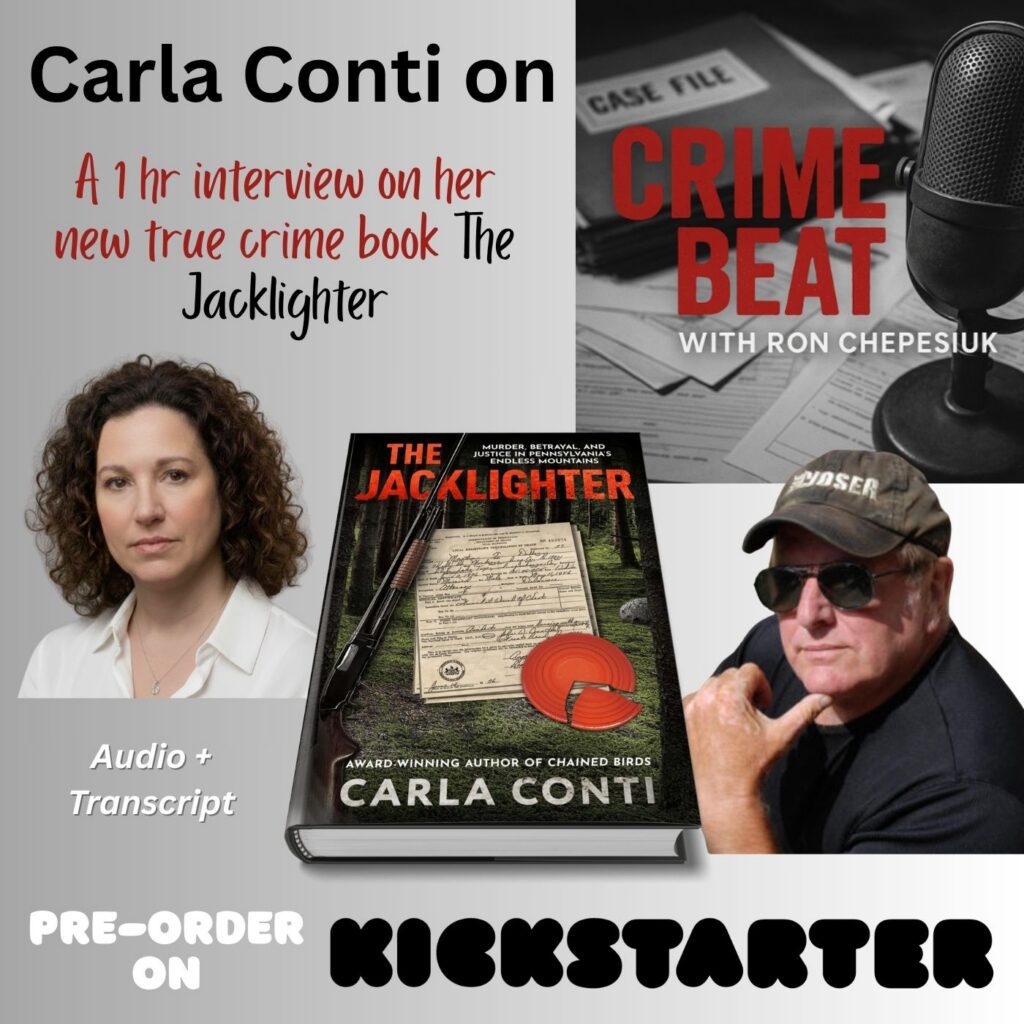
Last week I had the pleasure of joining the legendary Ron Chepesiuk for a full hour on his award-nominated show, Crime Beat—and it was the best conversation I’ve had about The Jacklighter so far.
We covered a lot of ground: how I first stumbled onto this story nearly 30 years ago in my husband’s hometown of Montrose, Pennsylvania; why I was scooped the first time around; and why I’m convinced my more complete version is the best one. We also talked about the remarkable chain of forensic breakthroughs, from a pig-skin shooting reconstruction to Henry Lee’s blood spatter analysis, that finally brought a killer to justice two decades after the crime.
You can listen to the abridged 45-minute radio interview below, and the full transcript follows for those who prefer to read. My interview portion begins after Scott Sliger’s announcements … Scott has announced Ron’s show for 15 years.
Ron is an incredible host, and if you’re not already a regular listener of Crime Beat, this is a great place to start. You can read more about Ron on his website, and the entire hour-long show is hosted on the Crime Beat page of the ArtistFirst Radio Network.
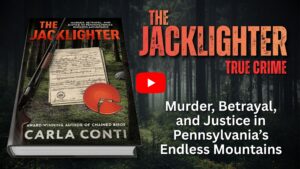
The Jacklighter: Murder, Betrayal, and Justice in Pennsylvania’s Endless Mountains is now available for pre-order on Kickstarter.
Carla Conti on Crime Beat with Ron Chepesiuk, March 19, 2026
Abridged Radio Interview Transcript
Scott: [00:00:00] Welcome to another broadcast of Crime Beat with Ron Chepesuik. The show that puts you, the listener, into the back alleys and boardrooms of the world’s most fascinating subject, crime. Crime Beat brings you a lineup of dynamic and provocative guests who allow you to experience their lives and learn more about crime. AL Prophet, the noted crime documentarian, says Crime Beat is the best show of its kind for the thinking listener, both entertaining and educational. Let me introduce the host of Crime Beat, a native of Thunder Bay, Canada, Ron Chepesuik. He’s an award-winning author, documentary producer and director, publisher, and screenwriter.
Scott: He’s the author of more than three dozen books and 4,000 published magazine, newspaper, and internet articles. Ron is a two-time Fulbright scholar to Bangladesh and Indonesia, was a consultant to the History Channel’s Gangland TV series, and has worked as an instructor in UCLA’s extension journalism program. Four of Ron’s books and several of his screenplays have been optioned for movies. For more information, visit RonChepesuik.com. Given his publications, extensive travels, and in-depth interviews, Ron Chepesuik today is the leading expert on the fascinating world of crime. Here he is, your host, Mr. Ron Chepesuik.
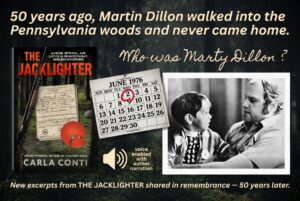
Ron: Thank you, Scott, for that nice introduction. Good evening, world. Well, this is our 744th episode of our award-nominated Crime Beat show … We have Carla Conti back, and she’s going to be discussing her new book, The Jacklighter: Murder, Betrayal, and Justice in Pennsylvania’s Endless Mountains. It’s a pretty fascinating story. Here’s the background. In 1976, attorney Martin Dillon went hunting with his best friend in Pennsylvania’s Endless Mountains and never came home. The only witness, Dr. Steven Scher, the man who was having an affair with Dillon’s wife. After investigators called in an accident, nothing happened. Nothing happened. But then Scher married the widow, and he raised her two children as his own. He lived a stolen life for 20 years until Dillon’s body was exhumed and everything unraveled.
Ron: Carla is the award-winning author of the true crime memoir Chained Birds: A Crimemoir, a prison abuse exposé about justice and survival in federal prison. It took Carla 10 years to write that as she balanced the safety of her story participants, including herself, in this tell-all thriller of prison gang hit orders and corrupt officials. We had her on the show to discuss that book, and now Carla is publishing The Jacklighter, and she’s back on again. Welcome to the show, Carla Conti.
Carla: Thank you, Ron. Thanks for having me back. [00:10:00] Actually, the book’s not out yet, it’s coming out this fall. But it can be pre-ordered.
Ron: I know. I’m amazed at all the work you’re doing for this book. Tell us a little about the background.
Carla: Well, this is a story that I actually got a hold of about 30 years ago when I was a really young writer trying to dip my toe into the true crime field. My background was as a reporter, and I used to cover the police beat, criminal courts, and things like that. And this story was taking place in Northeastern Pennsylvania in my husband’s hometown, a very tiny little hamlet called Montrose. And everyone in his family knew that I wanted to write true crime; they knew what my background was, and they said, “Carla, you should get up here and check out this case.” And that’s what started it all about 30 years ago.
Ron: Wow. So, why did it take you so long to write the book?
Carla: Good question. Well, I almost—and I’m holding my fingers about two inches apart—I almost got this story published 30 years ago as my first true crime book, which in itself is kind of a little side story to The Jacklighter.
Carla: But, but it’s relevant because, when this love-triangle-cold-case-murder story kind of exploded on the national news scene in the mid-1990s, numerous writers and authors were descending upon Montrose, and they wanted to write a book about this. So it really was a race to see who could be the first one to do it.Carla: I had a literary agent in New York City at the time, and I gave him my proposal for this book, and I told him that I had a lot of unique access to the players in this story because of my, so-called, you know, inside status, which really was totally due to my husband’s family connections. I was like an “almost insider”… And the story was getting picked up by People magazine, the Wall Street Journal, Time, and TV crews were coming out to do filming for it as it was ramping up and getting close to trial. So. I was one of those writers who thought they had an inside track on it.
Carla: And I worked on it for a couple of years. And kind of at the last minute, the woman who was writing for People magazine, covering the case, she had already written some true crime books—Maria Eftimiades. I had not published any books at that point. And she decided she was going to make that case her next true crime book. She already had a relationship established with a publisher, and St. Martin’s Press came out with a paperback book on this case shortly after the trial. So, you know, once it was announced that a publisher already had a deal with somebody, I was SOL as they say, you know?
Carla: So that’s why I didn’t get that story written. And, you know, life happens. Thirty years go by. And then of course, I got embroiled in the Chained Birds story in the early 2010s. So that’s how it happened.
Ron: Right. Well, do you think, after waiting 30 years, you got a better story?
Carla: Well, yes, actually I do have a much better story and I have a complete story.
Ron: Uh huh
Carla: Because the first book that came out, Secrets From the Grave, by Maria Eftimiades, in 1998, ended at the trial in 1997. But there were 10 more years of legal events and things that occurred, one of which was the killer was released from prison. A Pennsylvania court overturned his conviction and he was allowed to go free. [00:15:00] And, so there was plenty more to write about. That first book, by no means, is a full account of the case. Plus I have an awful lot of original reporting and unique things to my story that are not in the public domain, from the relationships that I’ve developed with sources and people close to the case. So, I feel like my book will be better.
Ron: Right. How do the people that you interviewed and are involved in the story feel about you, 30 years later, getting this book published?
Carla: Well, some of them are no longer alive. I have the confidence and the friendship of one of the main participants. This is the ex-wife of Dr. Scher, the doctor convicted in Marty Dillon’s death. I developed a relationship with her 30 years ago, and I renewed that relationship just last summer when I decided that I was going to write this book for good. She’s been a terrific source and very supportive of me wanting to get my version out there.
Ron: Right.
Carla: I’ve also talked to the victim’s sister, who has chosen not to be interviewed. She has said that the memories of that entire era and what happened with her brother and to her family, it is just too painful. She doesn’t want to revisit it, and I completely respect that. But she has pointed me to other kinds of written sources and things that I can use. And there’s a lot in the public domain about her, you know, that I’m able to use instead. So, you know, it’s been kind of mixed. Some people feel one way and other people are happy to participate or don’t mind participating.
Ron: Right. The Jacklighter, that’s an intriguing title, but what does it mean and why did you choose it?
Carla: Well, it is a hunting term. And the murder occurred during a skeet shooting—or trap shooting, as some people call it—event, between the two men in the case. So, you know, Marty is the attorney and he was married to a nurse, Pat. And Pat was having the affair with the doctor, Dr. Steve Scher. And he and Marty went skeet shooting one day, and only Steve Scher walked out of the woods alive. So, The Jacklighter is taken from the hunting term “jacklighting.” I can read the definition that appears at the beginning of the book …
Ron: Sure, go ahead.
Carla: It’s a hunter’s amoral killing of defenseless prey, also called illegal spotlighting. It’s a hunting method of shining artificial light on animals to stun or immobilize them, making them easier to kill. This unsportsmanlike conduct is illegal in most states, including Pennsylvania, where it was declared a crime in the late 1800s. [00:20:00]
Carla: The term ‘jacklighting’ dates back to colonial times when people went deer hunting at night with baskets of jack pine knots lit on fire. The knots were the hard, durable parts of jack pine wood, which contained a sticky resin that made for the best illumination. So the practice, which produces that deer in the headlights effect, gives hunters an unfair advantage over wildlife and is contrary to fair chase principles that form the ethical foundations of hunting.
Carla: So I call the murderer in this case a jacklighter, because this occurred in the woods while hunting, when his victim was completely defenseless, and it was a very cowardly way to kill.
Ron: Right. Well, given the time period of 30 years, were there any documents or interviews that changed your understanding of the case or make your story better?
Carla: Well, yes, I actually just learned from a source this week about a district attorney, in the very late 1980s and early 1990s, who refused to reopen the case. As you mentioned, the death was considered an accident for a long time. The doctor told a story of how the gun had discharged accidentally when Marty had been running with it and chasing a porcupine. That was the official story.
Ron: He changed his story later …
Carla: Yes, he changed his story later, but for a couple of decades, he kept to that story … over the years, people wanted to investigate it, but they just couldn’t really get enough evidence together. There were some officials who were thinking maybe they couldn’t get enough evidence for a conviction, and other people wanted to go full steam ahead, including the victim’s family. It was really the victim’s parents—Marty’s father especially—who pressed for this so hard that made it happen.
Carla: But I did learn about one district attorney who presented the shooting case with photographs and the original autopsy to a panel of forensic scientists in Philadelphia at the University of Pennsylvania in May of 1989. And a vote was taken by a show of hands as to the manner of death. The D.A. brought that information back to Montrose and told the victim’s family that most of the scientists voted that it was either an accident or possibly a suicide, and that he did not have a basis to reopen the case.
Carla: So what happened six years later, as Dr. Scher is finally being charged and they’re heading toward his trial in Montrose, is a forensic scientist testified at a hearing to exhume the body for another autopsy. A defense attorney asked this scientist if he was aware of how this forensic panel in Philadelphia voted—was he aware that the panel voted that it was either suicide or an accident?
Carla: And the scientist, on the stand, said, “I’m aware exactly how they voted. The vote was 28 to 2 that it was a homicide, because I was there.”
Ron: Oh.
Carla: And the district attorney was caught in a big lie.
Ron: Oh wow.
Carla: And I just learned this week that there’s a cassette tape of this forensic panel meeting. I’m trying to get a hold of that or meeting notes. I also heard through my source, which I am trying to confirm, that the district attorney did not willingly step down, but that he was forced to step down and not run for office again and turn over all of his materials, including the cassette, in lieu of being prosecuted for obstruction of justice.
Carla: He is the one official where there seemed to be—I’m not sure nefarious is the right word—but, you know, [00:25:00] bad faith behind not reopening the case. Otherwise, it just was kind of years of not the right people investigating, not having the right evidence, technology catching up, that kind of a thing.
Ron: Well, why would it be suicide? That’s the weirdest place to commit suicide. You go skeet shooting with a friend …
Carla: Right. Well, that was a strategy that the defense was floating at the trial. They wanted to portray Marty as being very depressed and despondent. He knew his wife was having an affair, and the doctor even came up with a story about treating him for depression.
Ron: And he goes hunting with him! He knows he’s having an affair with his wife, and he’s going hunting with him!
Carla: I know, I know. That’s a great question. Like, why, why would you go hunting with the guy who’s having an affair with your wife? I know. And nobody knows the answer to that question …
Ron: And what about the wife? Was she involved in any way in the event?
Carla: There’s no evidence that she was aware of anything that might be happening. And in fact, there is evidence that Marty gave her an ultimatum shortly before this “hunting incident” where he told her she had to choose between the doctor or him. Now they also had two small children, a 3-year-old and a 5-year-old, and both Marty and his wife Pat were very staunchly Catholic and divorce was unheard of, out of the question, for Pat, at least. And I believe she struggled with the decision and even told a friend that she loved both men, that she wasn’t sure what she would do. But the prevailing theory is that she told Marty she would return to the marriage, the affair would be over, and this was not acceptable to the doctor, who was used to getting his way.
Ron: Right. Right.
Carla: And the day of the shooting, there were supposed to be at least three other guys with them skeet shooting, because this was an every-other-Wednesday event amongst professionals in this small circle in Montrose. They called themselves the Wednesday Afternoon Club, but for various reasons, some of them just couldn’t make it that day. It was one guy’s wife’s birthday, he needed to take her out to dinner. Somebody else had too much work and couldn’t make it, and it just ended up being Steve Scher, the doctor, and Marty, and both of them went forward with the plans. They didn’t change the plans, and at some point, you know, murder crossed his mind as the way to get Pat for himself because she would never divorce Marty.
Ron: Right. Do you think it was a spur-of-the-moment decision to commit murder?
Carla: It’s hard to know. I have some theories that I’m exploring towards the end of the book. I’m laying them out and talking with other people. We do know what some of their conversations likely were. The doctor testified to what conversations they had, not that you can believe that testimony, but he did say they discussed a big murder trial that Marty was going to be the defense attorney for coming up in a couple of days. So, oddly, they were discussing murder, and the doctor was an opportunist.
Ron: Mm-hmm.
Carla: And at some point, he decided he was going take his chance.
Ron: Right. The prosecutor described Dr. Scher as an arrogant man with a God complex. Do you agree with that?
Carla: Yes. Well, he was very arrogant and used to getting his way. And he even had conversations with people who testified [00:30:00] about how he would say, “I’m used to getting what I want, and I’ll do whatever I need to do.”
Ron: Yeah. Well, wasn’t that part of the reason why investigators initially ruled Dillon’s death an accident—his reputation within the community? You know, a man of his stature couldn’t possibly have committed this murder so reasonably?
Carla: Exactly. Yes. He was a well-respected doctor. The coroner who came out to the shooting scene was told by the doctor that Marty had been running after a porcupine, tripped with the gun, and it discharged accidentally. The coroner didn’t have experience seeing that kind of gunshot wound, knew the doctor, and, of course, just took the doctor’s word for it. And then the coroner translated that story to a rookie trooper who was next on the scene, and the story just became ingrained pretty much except for a very savvy, hard scrabble county detective named Jock Collier. He got a hold of the case and brought the doctor in for questioning a couple of days later, and smelled a rat.
Carla: Jock Collier tried for years to get his boss, the county D.A., to press charges against the doctor, and he couldn’t get his boss to do it. He couldn’t get anyone to follow through on it. The D.A. at the time felt that they didn’t have enough evidence and, you know, people believed the doctor, and he just didn’t think that they could get a conviction.
Ron: Right. Did Dillon’s wife believe that he was innocent? Because she married him, which was amazing.
Carla: Well, if you believe her story at a press conference years later, as they got close to trial time, she said at the press conference, that she never had to ask him because he was a “healer.” She watched him care for patients. And he was a good, kind man—and he had found religion at that point—and she never had to ask him that question. If you can believe it, she never asked. She never asked him that question … This is what she said at a press conference. Who knows what their pillow talk may have been?
Ron: Well, what about the kids? They were very young when it happened, but when they grew up, did they believe it? That their stepfather was innocent?
Carla: They did believe his story, and they were staunch supporters of him through that trial. They were young adults at the time … And actually, that’s one of the reasons that Marty’s father waited enough years to really try and press authorities to reopen his son’s case, to get his own investigation going as part of it, because he wanted those kids to be adults. He didn’t want to lose them and harm the relationship that he had with them. But when the trial came, the kids were firmly in the doctor’s corner because they had been raised by him. They really didn’t have memories of their father, Marty. And by all accounts, Steve Scher was a very good stepfather to them.
Carla: The daughter inherited some life insurance money from her father, Marty, and she turned it over, $65,000, to his defense. That’s how much she believed in him.
Ron: Well. It almost sounds like a cult.
Carla: Yes. You know, the real tragic part of all of that for the family is that they risked everything to get justice for their son, their brother, and in the process, they did lose those children. Pat made sure that they never had a relationship after charges were brought because they knew that this was spearheaded by Marty’s father. And the children were so [00:35:00] brainwashed, for lack of a better term, and just seemingly turned a blind eye to all the blatant evidence that he was guilty … just disassociated from it. And they haven’t ever wanted anything to do with their Montrose family ever again. That’s a really tragic part of the story.
Ron: Did you manage to interview them?
Carla: I have not found them yet. They live in another part of the country. One of them has changed their name. I’m going to do my best to make contact, see if they would like to have input on this story, and let them know what I’m doing. I suspect they would not like to hear from me, but, you know, I’ll do my best.
Ron: Well, let’s stop there. We’ll continue this story after we take this break.
Scott: This is Crime Beat on the ArtistFirst Radio Network. Send us your questions and comments: Crimebeat123@yahoo.com. Back to your host, Ron Chepesuik.
Ron: Thank you, Scott. We’re here with Carla Conti. We’re discussing your fascinating book, The Jacklighter: Murder, Betrayal, and Justice in Pennsylvania’s Endless Mountains, and the killing of Martin Dillon by Steven Scher. The book is not out yet, right, Carla? But where can people find the book, and when is it going to come out?
Carla: Well, people can find it right now on Kickstarter. It just went live for getting pre-orders this week. So anybody can go to the Kickstarter platform and just look up The Jacklighter, or my name, Carla Conti, and you’ll find it. It’s essentially a campaign for pre-ordering and getting special bundles … maybe some people like to have the audiobook along with the paperback etc. A lot of the bundles include my first book, Changed Birds, so people can go to Kickstarter to pre-order it. Now, I am saying it’s coming out by the end of the year, but I think it will be out in the early fall.
Ron: Okay. Let us know, and [00:40:00] we’ll broadcast it on our show. Getting back to our show discussion … after Dillon’s death, Scher marries his widow, and he does he manage to rebuild his life successfully. What was his reputation like? And what do the townspeople do? I mean, how can you live with this for 20 years and, you know, still build a remarkable life?
Carla: Well, he moved away. He married Marty Dillon’s widow, Pat, and they moved to New Mexico for a while, and then they moved to North Carolina. And in both places, he had very successful practices, and patients quite liked him. In fact, he had a lot of patients and people from those communities testify to his character. Back in the 1970s, when this murder happened, he claimed to be an atheist, and he also kind of complained that he was one of the only Jewish people in town. And then he became very religious after he married the widow, and started going to the Catholic church in both locations, and became quite a benefactor, contributing a lot of money. So he really had a whole different lifestyle or, shall we say, persona, afterward.
Ron: Right. And the marriage went well?
Carla: Yeah. She stuck with him the whole time.
Ron: Oh, wow. On that then, what changed 20 years later … I guess the family was relentless in saying that Scher was guilty and they wanted justice, right? Was that the main factor getting them to reopen the case?
Carla: Yes. And there was also a very important person who helped get the case to its next level, where he was finally charged, and that was Marty’s secretary, a woman named Bonnie Mead. Bonnie was a young secretary in her twenties when Marty was killed, and she was very fond of her boss. And in the late 1980s, while working at an insurance firm, she helped bring into the firm somebody who performed accident reconstruction for automobiles. And she started thinking and wondering if this accident reconstructionist couldn’t then possibly try to reconstruct that shooting. And the reconstructionist, who was a local guy and had gone to school with one of the family members, really did try to re-stage the shooting using pig skin filled with red dye, to simulate human skin. And they were able to determine that the shotgun had to be at a certain angle and much farther away than the original story indicated.
Carla: That [00:45:00] was one of the first things that got the ball rolling. And then a succession of Pennsylvania police investigators would kind of dive into it, and then something would happen, that investigator would get transferred or retire, or whatever, and then the next one would take it on. And at that point, technology was starting to catch up. You know, they didn’t really know much about blood spatter and things like that back in the 1970s. One of the things that led to charges and his trial was a very famous forensic scientist, Henry Lee—you may remember his name from the O.J. …
Ron: The one in the O.J. Simpson trial?. Yeah. Right.
Carla: Yes. So he examined the shotgun, the boots that the doctor was wearing, a tree stump that was spattered with blood, and clothing that the doctor and victim were wearing. All of these things had remained in an evidence locker because of that detective I told you about, Jock Collier, who unfortunately died before this could ever be resolved. The detective made sure that all of those pieces of evidence remained sealed in a locker. So Henry Lee was able to look at these things and determine that blood spatter happened at a certain point and trajectory … the doctor’s boots and the bottom of his jeans had this blood spatter on it.
Carla: So how could Scher be farther away from the shooting location, down the path where he said he was, when Marty was chasing a porcupine and the gun went off? Well, the blood spatter shows the doctor was there, and that Marty was probably either kneeling or sitting on that tree stump when he was shot, getting ready to load more clay pigeons into the trap flinger.
Ron: Right.
Carla: And also, Marty was wearing ear protectors and sunglasses at the time, and those were spattered, and that tells its own story as well.
Ron: So, how did the defense counterattack that theory?
Carla: Well, because of the rules of Discovery, where the defense is allowed to see what materials the prosecution has, they knew that the prosecution had all of this blood spatter evidence, and that the original story was not going to hold up. So what did he do? He changed his story on the witness stand. And his story was that the topic of the affair did come up, and they got into an argument, and the doctor was almost worried about what Marty was going to do with the shotgun that they struggled over, that he thought Marty might have intended to harm himself with it because he was so distraught over this affair … and they struggled and the gun went off.
Carla: Shocker, that was his story. That’s how he changed it. But guess what? He forgot something. [00:50:00] He forgot that Marty was wearing ear protectors. Now, does someone have an argument with somebody else while wearing earmuffs, and you can’t hear them talk?
Ron: Ah ha, so how did the defense counteract that?
Carla: They ignored it. They ignored it because they just didn’t plan for that, and the jury saw right through it.
Ron: Right. I mean, they’re not dumb. That’s amazing. Amazing. So that’s why they reached a verdict so quickly?
Carla: It was about five hours. And they had an alternate juror who was seated after they started deliberating because one of the female jurors, for whatever reason, could not continue on, and I think she even locked herself in the bathroom. It was a little dramatic. And so one of the alternates had to go in. And believe it or not, that formed the basis of a successful appeal.
Ron: Mm-hmm.
Carla: Because the defense at the time was not able to quote unquote “reinterview” that alternate—even though all the jurors and alternates had been interviewed in voir dire … so two years later, a Superior Court in Pennsylvania overturned that conviction because of that alternate juror going in at deliberations, and he was released.
Ron: Oh my God. He went back to his business and life?
Carla: He lost his medical license, but he did regain his freedom … I’m not going to give away the ending, because there were two more legal events that happened after that. That’s why my book is the definitive full accounting of this story, whereas the first book, you know, left off after the 1997 trial.
Ron: Yeah. That’s really amazing. So how did the Dillon family react?
Carla: Well, they had two frames of mind. In 1997, they were just desperately pleased to finally have justice for their beloved son and brother. But at the same time, they lost two grandchildren, their niece and nephew, through the whole situation, so that was devastating for them. Now Marty’s father died before the Superior Court overturned the conviction, so he died with the knowledge that his son’s killer was brought to justice and would go to prison. Some people think that was a good thing. But it was tumultuous for everyone and the town to go through this roller coaster of emotions, you know?
Ron: Yeah, exactly.
Carla: “We thought this conviction stood—what happened? How could this be?” There was no question that he was guilty. And so another court eventually ordered a new trial, and everyone had go through all of this again. So that’s where I’ll leave that mystery for you.
Ron: Right on that. Well, we’ve only got a couple of minutes left. Are there any lessons that investigators can take away from this case, if they studied it?
Carla: Well, you know, it’s hard to think of lessons when you’re talking about a case that originated in the 1970s, when they didn’t have certain technology.
Ron: Right.
Carla: But also, the county detective at the time, Jock Collier, definitely smelled a rat. He knew about the affair. The whole entire town knew that the doctor and the nurse were having this affair, and he still could not get the D.A. to think about convicting this well-respected physician. So I’m not sure there are any lessons, except that it’s just a real snapshot in time of where prosecutions were and how stories get ingrained and believed. I find it all fascinating, actually. [00:55:00]
Ron: Well, we’ve got a question or two left in the last couple of minutes. Did writing The Jacklighter have any effect on you? Has it changed you or made you think about certain things?
Carla: Well, okay, I’ve had these boxes in my basement, or I should say basements plural, because I’ve moved around over the 30 years since I started this story. And then I unearthed these boxes, and inside was my original book proposal—proposals are summaries of each chapter, a very condensed version …
Ron: Probably typewritten.
Carla: Yes, definitely typewritten. But I did complete a final last chapter, and when I read it again, I was shocked to see that, with a little editing, it was still the perfect ending for The Jacklighter—it’s going to be my epilogue. And I actually got a little emotional as I added it into my current manuscript, because it’s a narrative that I hadn’t fully remembered. It’s based on a meeting that I had with the victim’s parents at the hunting camp called Gunsmoke, where the murder took place. So it was very emotional to read it. I’m so glad that I kept all my notes, and now it’s going to be part of the book 30 years later.
Ron: Great. Everybody has a happy ending. And with that, we’re going to end the show tonight. It’s been a real pleasure having you back on the show again, Carla Conti. The book is The Jacklighter: Murder, Betrayal, and Justice in Pennsylvania’s Endless Mountains–the killing of Martin Dillon by Steven Scher. The book’s not out yet, it’s going to be out by the end of the year. Carla will let us know when the book comes out, and we’ll announce it on our show. Thank you so much, Carla, for coming back on again. It’s been a really great experience.
Carla: Oh, it’s been my pleasure, Ron. Thanks for having me back.
Ron: Thank you. Have a great evening.
Carla: You too.
Ron: Thank you. Wow, that’s a really great story. We’ll get the book when it comes out. Just a reminder that the next program is March 26th, 2026. We’ll have Anthony Arillotta and Joseph Bradley to discuss their book, The South End Syndicate: How I Took over the Genovese Springfield Crew. We hope you enjoyed Crime Beat this evening, on the ArtistFirst Radio Network. Wherever you are tonight, I’d like to thank all of you for listening to our broadcast this evening.
Ron: In the meantime, we welcome your emails and thoughts about our program. Email us at crimebeat123@yahoo.com, and please spread the word about our show. And until next week … we hope you tune in to Crime Beat next Thursday, same time at 8:00 PM for our 745th show. That’s Eastern Standard Time, where you’ll have a front row seat to the fascinating world of crime. Sleep tight, everybody.

Carla Conti is a journalist and the award-winning author of Chained Birds: A Crimemoir. Her next true crime book, The Jacklighter, is set for release in 2026. She lives in Pennsylvania with her husband, who supports her true crime habit.