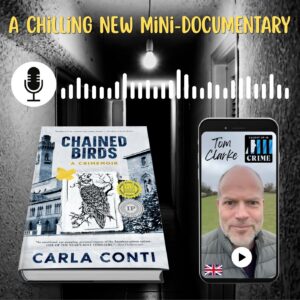
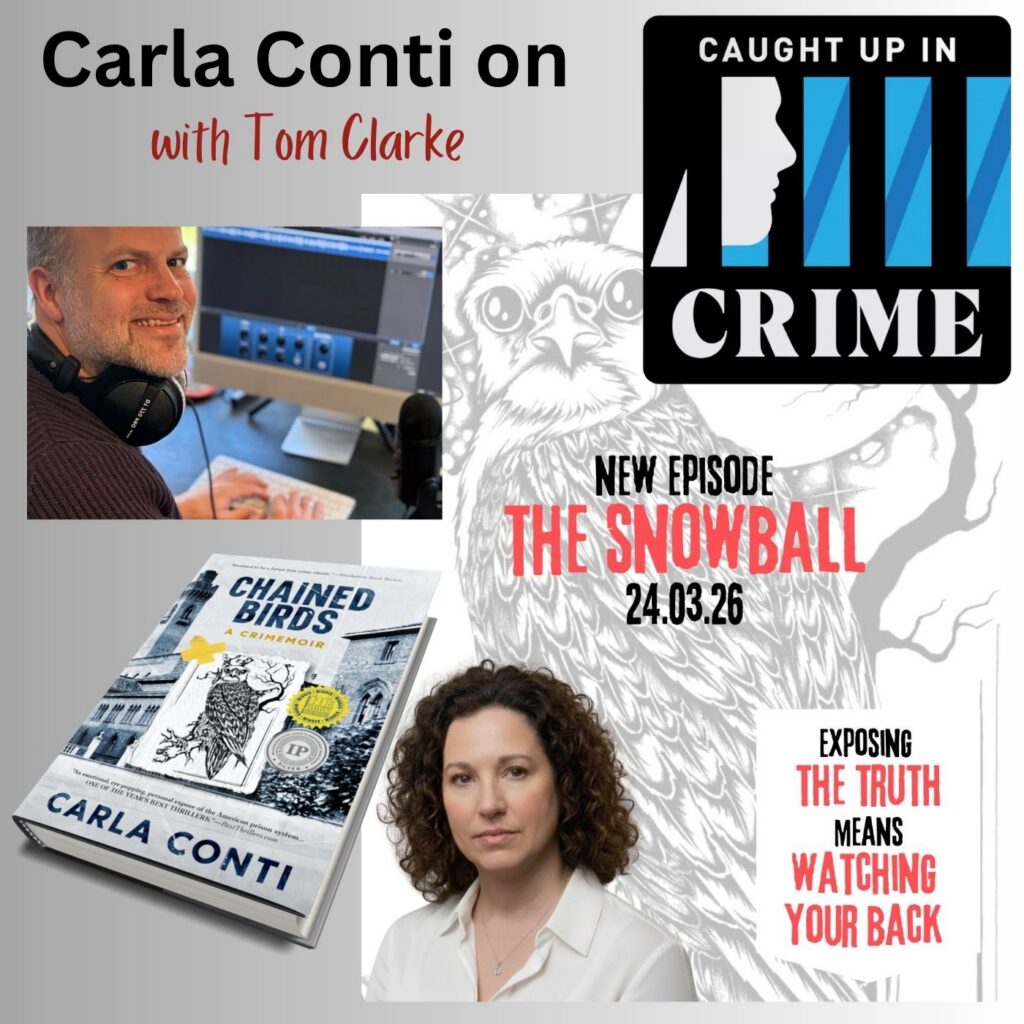
I’ve done more than a dozen podcast interviews about Chained Birds, and I say that with deep gratitude. But this one is different. This one stopped me in my tracks … and that was before I saw Tom Clarke’s video intro to his cinematic-for-the-ear episode called “The Snowball.”
Caught Up in Crime is the brainchild of Tom Clarke, a UK-based podcaster, writer, and content strategist who came to true crime by a wonderfully circuitous route. In 1999, he began a corporate communications career almost by accident, then spent 16 years at PR Newswire, and then in 2016, took a freelance pivot that let him pursue his twin passions: press releases and, yes, true crime. He lives in Chesham, Buckinghamshire, with his wife and two daughters, and he also somehow finds time to write crime fiction and bleed loyally as a West Ham United supporter … Suffice it to say, the man was born to tell stories—and to suffer. 😂
What Tom has built with Caught Up in Crime is something I genuinely didn’t expect: a cinematic listening experience. The episode isn’t just an interview. It’s a fully produced audio narrative, layered with music, sculpted through editing, and shaped with the kind of care that makes you feel like you’re inside the story rather than being told about it. Tom has a rare gift for listening between the lines of what a guest says and pulling out the best, dramatic bits underneath. He doesn’t just ask questions, he builds a world around the answers.
Episode 18 is called “The Snowball,” and if you know the book, you’ll understand why that title is so perfect. What Tom has done here—his storytelling about my storytelling—is something I’m still processing. He frames Chained Birds and my decade-long odyssey with a clarity and rhythm I didn’t know the story could have in audio form. I am truly honored 🥹
You can find the listen links below, and the full transcript follows for those who prefer to read … but truly, you’ll miss out if you don’t experience Tom’s audio showpiece ✨
-
- Listen on Caught up in Crime
- Listen on Spotify
- Listen on Apple Podcasts
Transcript of the 35-minute episode, “The Snowball,” on Caught up in Crime, March 24, 2026
Carla: [00:00:00] I was very glad to be on the other side of the country, but I was worried, scared, paranoid, you know, looking over my shoulder and in my rear view mirror all the time. In my mind, I thought, there is no way I’m writing this book because he said everybody in the prison system knew I was writing this book. He had told everyone …
Carla: Because, of course, if you’re in prison and somebody’s gonna write a book about you, you’re gonna brag about that. So I think he bragged about it to everybody on the bus. And we think there was at least one Montañista spy that had traveled with him from the Florida prison to his release off that bus.
Carla: Our first call, was him telling me that my life was in danger.
Tom: Every crime journalist dreams of that one story that’ll help them hit the big time, but sometimes you can get dragged in way too deep. I’m Tom Clark, and this is Caught up in Crime, a podcast about ordinary people who suddenly find themselves caught in the crosshairs of a bitter dispute between warring prison gangs.
Tom: This is episode 18—“The Snowball.”
Carla: Well, my name is Carla Conti. I am an award-winning true crime author with my debut book called Chained Birds: A Crimemoir.
Tom: Actually, Carla isn’t Carla, at least that isn’t her real name. When I met her on Zoom, the name on the screen was entirely different. Protecting her true identity has been the price she’s had to pay for success.
Tom: Writing her debut book, Chained Birds has been life-changing professionally, but it’s also opened her up to dangers from the violent gangs that run America’s federal prisons and their shady connections on the outside world. It’s all a far cry from her old life as a local journalist.
Carla: I did enjoy my journalism career, uh, early after college and in my early married days, I was a reporter in the Midwest for a series of newspapers. And aside from crime and court reporting, we covered all kinds of silly stories. I remember sitting in a graveyard one time with our photographer and a colleague, and we were waiting for, I don’t know, some scary thing that was supposed to appear, which of course didn’t appear, but we wasted a whole night in a graveyard.
Carla: I enjoyed those kind of weird things, so I guess it’s not surprising I ended up writing True Crime.
Tom: Carla worked these local stories for years, writing up court bulletins and camping out in graveyards. Dreaming of that one big story that might turn her into a published author. But as is often the case with these things, when the moment came, the initial pitch didn’t sound too promising.
Carla: I got involved back in 2011 because of my high school friend Scott Powell, who was, at that time, kind of a washed-up public defender and was the defense attorney for the character at the heart of this story, federal inmate Kevin Sanders.
Tom: Scott evidently had the gift of the gab. Because he’d known Carla since high school, he knew exactly which buttons to press.
Carla: So it was Scott who kind of dragged me into the case a little bit. I was reluctant at the beginning, but he knew my journalism background and I also knew how to make websites, and he wanted the combination of those two skills. He wanted me to make a website and write about his client to try to raise money for his defense and also bring awareness to a really terrible experimental prison program that was happening in Lewisburg at the Special Management Unit in [00:05:00] Lewisburg, Pennsylvania. That’s where his client, the inmate at the heart of this book, Kevin Sanders, was incarcerated.
Tom: Carla talks about this early introduction to Kevin’s case at the beginning of Chained Birds, and when I read it, I was immediately struck by the camaraderie of Carla’s old school gang. It’s something I’m sure most of us can relate to. You could be apart for years, but at every get together, you’re immediately back reeling off the old stories, finishing off each other’s sentences.
Tom: It was maybe because of this closeness that Scott was able to coax Carla into joining the team.
Carla: He really sort of pestered me over the course of a few months. “Oh, you should really write about my client. He’s involved in some really interesting things at this prison …” And he talked about prison stabbings and the Aryan Brotherhood, and I was just thinking, no way do I want to get involved with that.
Carla: So I would always say no, always say no. And, he just kind of wore me down a little bit, but I could tell he needed help also. He was a lone defense attorney, trying to defend this client. He had no investigator, you know, he wasn’t getting any funding or any help from the judge who oversaw the case.
Tom: Despite her reservations, Carla had to admit that Kevin’s case intrigued her. As a favor to Scott, she wrote the article and designed the website, and before she knew it, there was no turning back.
Carla: And one thing led to another, and then suddenly I became part of the defense team because he sent me a letter and a dollar, and that was my payment. And technically, that had me become part of the defense team, and I was like sworn to not reveal our secrets, et cetera. It was just kind of an odyssey.
Tom: As you might have guessed, although this is a story about the federal prison system in the United States and the gang violence that’s rife within it, at its heart is one man. Kevin Sanders is the central character in Chained Birds. And for more than a decade, Carla was his advocate, his biographer, his friend.
Carla: When I met Kevin, he was 36 years old. He had been incarcerated for most of his adult life for nonviolent drug crimes and petty theft crimes as a juvenile, things to help support a drug habit.
Carla: He grew up in California in not the best of environments. His mother was an alcoholic. He was shuttled back and forth between his mother and—he actually didn’t even meet his real father until he was about 11—and he kind of begged his father to be able to go live with him because his mother did not provide stability.
Carla: They lived out of their car a lot. They were homeless due to her alcoholism. So he moved in with his father, who was a Hell’s Angels Chapter President.
Carla: … I don’t know if in the UK you know who the Hell’s Angels are, but here that’s a biker gang.
Tom: I think, um, I think Hell’s Angels in the UK are just a staple of every Hollywood film where there’s a bar brawl and the kind of guys with big hair and big leather jackets, necking beer, and then beating each other up over a pool table. That’s kind of how it goes.
Carla: There you go. That sounds about right.
Carla: So he was in this environment from the age of 11, and drugs were plentiful, beer was plentiful.
Tom: It wasn’t all bar brawls and motorcycles. Kevin showed glimpses of real creativity amid the madness.
Carla: He was naturally gifted as an artist. So his father was a tattoo artist, and his father also painted and airbrushed designs on car hoods and the fenders of Harley’s. And so Kevin picked up the skill from his father, and he already had the natural ability. So that actually ended up serving him for many years, the years that he was not in prison. But then also, when he was in prison, he was a prison tattoo artist.
Tom: But his father’s real legacy was passing to Kevin, his other gift.
Carla: And as he grew into an older teenager and a young man, his father taught him how to cook [00:10:00] meth.
Tom: If you’re picturing something out of Breaking Bad, well, that’s about right. Almost inevitably, Kevin’s trailer was raided by the ATF, the Alcohol, Tobacco, and Firearms Agency of the Department of Justice.
Tom: Ironically, it wasn’t the A or the T or even the piles of meth that got him in trouble. It was the F.
Carla: Even though there were all kinds of drugs and drug paraphernalia on the property, he was found to have a sawed-off shotgun.
Tom: For reasons that even Carla isn’t quite clear about, the police were tipped off about the gun by Kevin’s own father. Before that raid, Kevin’s issues with the law had mainly been drug-related and handled at a state level, but the gun charge changed all of that.
Carla: He received a big gun charge because of that, and that is what sent him into the federal system and into the Pennsylvania prison where he got embroiled in everything that led into Changed Birds.
Tom: Kevin would spend the next seven years at the Allenwood State Penitentiary in Pennsylvania. And he soon found out that if he was gonna survive, he needed protection. Kevin was white, but he spoke fluent Spanish after running with a Hispanic gang back in California. And to him, the only choice once inside Allenwood was to join a group called the Montañistas.
Carla: So he rose to a certain level of responsibility with the Montañistas, to the point where he actually was running the yard, as they call it, the prison yard. He was in charge of lots of activities for the all gang members. You know, making sure that they did their exercises and they suited up when they needed to.
Carla: And this was a gang that had very strict no-drug policies, and he adhered to all that, and he just kind of had to help keep people in line, but also take orders from the shot-callers: the people who were in charge of this gang.
Tom: In prison, these shot-callers rule the roost. Kevin knew not to cross them, but for a nonviolent inmate like him, trying to keep your head down and stay out of trouble was easier said than done.
Tom: Things came to a head when he was ordered to assault a fellow inmate. He refused—a decision that might have eased his conscience, but didn’t cut it with the shot-caller. The Montañistas turned on him and he was placed in solitary confinement for his own safety. The authorities knew that a hit order was out on him, so they had to get him out of there fast.
Carla: So he transferred to Lewisburg, Pennsylvania, which was like 12 miles away … I called it an experimental prison program. It had just opened, they called it the Special Management Unit.
Tom: Lewisburg was one of the most notorious federal prisons in the country. In the 1960s and 1970s it was home to mafia royalty like John Gotti, Jimmy Hoffer, and Henry Hill, the man made famous by the film Goodfellas.
Carla: And it was really meant for hardcore violent criminals, who either committed seriously violent crimes to get there: murder, rape, major assaults, and then continued assaulting and causing these kinds of troubles while behind bars. And Kevin did not fit that criteria. He had never been incarcerated for anything violent.
Tom: A new prison meant a new gang, new allies, new enemies.
Carla: Because he was white and he had to align with another racial gang, the Caucasians got hold of him, and that was the Aryan Brotherhood. He was assigned to cell with a Nazi Low Rider, which is one of the many foot soldiers of the Aryan Brotherhood here. And he found himself embroiled in an orchestrated recreational cage assault.
Tom: Kevin didn’t know it at the time, but he and his cellmate, the Nazi Low Rider, known as Arson, because of his short temper, rather than any pyromaniac tendencies, were about to be tested to prove their loyalty to the Aryan Brotherhood.
Tom: They were exercising one morning in a cramped cage in the yard. When a third inmate named Oakie was sent in to join them by a grim-faced guard, who then locked the door and swiftly retreated. Kevin’s heart sank. He instantly recognized the gravity of the situation. Oakie was a sworn enemy of the brotherhood, and this was a chance for the gang to leave their mark.
Carla: And when they were in [00:15:00] this rec cage, the orders were being called out from the windows to “hit this guy, get this guy,” meaning that Kevin and Kevin’s cellmate had to attack Oakie.
Tom: Arson produced a makeshift shank and began punching and stabbing the interloper. Kevin, unarmed, piled in beside his cellmate, raining down blows in a stabbing motion, hoping to appease both Arson and their Aryan Brotherhood shot-callers, who were hanging out of the windows banging for blood.
Tom: The guards hung back for some time before eventually dragging Kevin and Arson away, leaving Oakie in a pool of blood in the cage.
Tom: In that moment, Kevin knew he was in big trouble. What he didn’t realize was what had happened to put him in that cage in the first place. How a single seemingly childish and innocent moment several months before had left him facing a new fight for his life and his freedom.
Carla: Basically, this whole entire Chained Birds story I realized started with a snowball fight.
Carla: It was a momentary act of defiance on the part of an inmate nicknamed Oakie (because he was from Oklahoma) … he happened to see a prison guard that he knew from a different prison. The guard had just transferred to Lewisburg, where Oakie was, and he had been abused by that guard. And so Oakie threw a snowball at this guard, Captain McDonald, and Captain McDonald, after the scuffle, vowed vengeance. He said, “Who around here can I put you in a cage with?”
Carla: And not long after that, he made good on that threat. And coincidentally, Oakie was not in good standing with the Aryan Brotherhood—he had caused some trouble for them on the inside. So the two entities conspired with each other, Captain McDonald and the Aryan Brotherhood, to put Oakie in a rec cage where he would be assaulted. And who ended up in that rec cage, but Kevin and Kevin’s cellmate, Arson.
Tom: Okie survived the attack, but only just.
Carla: He had a punctured lung, and he spent a few days in the hospital. Lots of scrapes and cuts and stab wounds—all on the side where Kevin’s cellmate, Arson, had been attacking him. There were no stab wounds on the side where Kevin was, because Kevin did not have a shank, but he was making it look good for anybody who was watching.
Carla: So that rec cage fight led to assault charges, which is what led my friend Scott to become Kevin’s public defender, and that’s how I was brought in to the case.
Tom: Kevin and Arson were both charged over the assault on Oakie, and were looking at an additional 10 years in prison. For Kevin, that was out of the question.
Carla: At the time of the rec cage assault charge, Kevin was what they would call “short” quote unquote, meaning he was just a few years away from completing his sentence, and that was that 10-year gun charge sentence. So he was very angry that he had been put in that position of—you know, kill or be killed, assault, or be assaulted – situation. And he wanted to tell the truth in open court, he wanted people to know, and Scott was not sure that that was the right course of action. Typically, most of these kinds of cases are pleaded out, and he had in front of him a plea deal from the prosecutor for five years—and, you know, you’re done.
Carla: His cellmate, Arson, took the five-year plea deal, and Kevin convinced Scott that he wanted to take it all the way to trial because he wanted the truth to come out.
Tom: In many ways, Kevin was lucky to have Scott as his public defender. Often these cases involving career criminals don’t exactly invoke empathy with the lawyers hired to represent them.
Tom: But there was something about Kevin that lit a [00:20:00] fire inside Scott and in Carla too. And so it was that the two old school friends and another lawyer named Jack Bear dropped everything else in their lives to work on Kevin’s defense.
Carla: It was pivotal because I felt like I was contributing …this was my job, so to speak. I wasn’t getting paid for it, but it was something that I was contributing toward, and I know I was helpful.
Tom: It was an intense period in Carla’s life and an eye-opening one. Kevin’s experiences highlighted a system that was clearly broken, where brutal gangs and corrupt guards could literally get away with murder, and where the legal system was either too damaged or too indifferent to do anything about it.
Tom: Still, they thought they had a pretty good case and they made a good team.
Carla: We were so glad to have Jack join the team as pro bono because he was more experienced than Scott, older than Scott, and we really relied on his prior knowledge. He was very experienced with federal criminal cases as well, and this had been Scott’s first federal criminal case.
Tom: Kevin’s defense was built on a combination of solid evidence and mitigating circumstances. The team argued that once he and Arson were locked in that cage with Oakie, Kevin had no choice but to fight. If he’d stayed passive, there would’ve been deadly consequences at the hands of his Aryan Brotherhood, shot-callers. It was kill or be killed.
Tom: It also showed that the stab wounds were clearly inflicted by arson, not Kevin. They show that Kevin’s record to that point had been entirely nonviolent. He’d risked his life inside Allenwood by refusing to assault a fellow inmate, remember? So this was a guy who tried to avoid violence at all costs. They even found an expert who agreed to testify about gang culture to prove that Kevin was merely a pawn in a conspiracy to get revenge on Oakie after he threw that snowball.
Carla: There was some exculpatory evidence on the video surveillance tape that we felt was missing at the very beginning, where Kevin made very clear motions to the prison guard, not to even put Oakie in the rec cage to begin with.
Tom: Unfortunately, the jury never got to see that footage, nor did they get to hear from the expert witness because the judge denied Scott the expenses needed to bring him to court to testify.
Tom: Throughout, there was a feeling that Scott and Jack and Carla were being punished simply for challenging the system and for standing up for a man like Kevin.
Carla: And typically, a jury is not really predisposed to want to believe or have sympathy for a prisoner, an inmate who’s covered in tattoos.
Tom: By the end of the trial, there was a brutal inevitability about the result.
Carla: From all of those challenges, we did lose at trial, and we did appeal. We had a big Brady violation, which I’m not sure if your UK folks know, but you have something similar, where exculpatory evidence has to be revealed to the defense side. Despite all that, we lost the appeal as well, and he got seven more years.
Tom: Seven more years. Even Arson, the guy who’d done the actual stabbing, would be out in five, as he’d taken the plea deal when it was first offered without dragging Lewisburg’s name through the dirt. Even more serious was the damage to Kevin’s reputation. He’d become a narc, a whistleblower against the natural order of the federal prison system, and that made him enemies across the board.
Carla: Before the trial and appeal process was completed, he was sent to an interim prison in Colorado, where an Aryan Brotherhood of Texas associate tried to kill him. He was ordered to try to kill him, because Kevin had testified at trial about the gang, and Kevin knew that testifying at trial would put him in that position … and Kevin narrowly escaped being stabbed in the heart by this Aryan Brotherhood of Texas associate.
Tom: Kevin transferred to another federal prison this time in Florida. The time was dragging, but at least he was out of Lewisburg and the Special Management Unit. [00:25:00] In a bizarre twist, he befriended the legendary Boston crime boss, Whitey Bulger, and they developed a close bond, but his friendship with Carla ran deeper.
Tom: By now, she was committed to writing a book, to telling his story, and that allowed him to dream of what life might be like when he finally got out.
Carla: I maintained a friendship and a connection with Kevin—I was basically his advocate on the outside. He wrote me letters, we had phone calls, I sent him things, I put money on his books for the commissary. And I think one of the things that kept him going was the idea that he and I were writing this book together, that he was contributing to a book that would reveal all of these things that he wanted people to know about.
Carla: I felt good about that, giving him a purpose. He made wonderful drawings and sketches that he sent me all the time, that he always hoped would be in the book, and they are. So I basically followed his odyssey for those seven years that he served out in that Florida prison. And a lot of crazy things happened to him there just because it’s federal prison.
Tom: Kevin was released from the Florida prison in April, 2021. At that time, COVID was still rife and it limited his options as to where he could be released to. He’d been scheduled to go to a halfway house, but the policy was abandoned due to national restrictions. Carla thinks that if he’d been given that opportunity, things might have turned out differently.
Carla: He was only able to be released to the place that he came from, which was California, which was a hotbed of gang activity and not the best place for him. Scott and I tried to see if the Bureau of Prisons would release him into Scott’s care, for instance, where Scott was living, and we wrote letters and had phone calls … And the Bureau of Prisons just—they had their processes, and nothing was going to change. And so Kevin was released back to California, on a one-way bus ticket.
Tom: Carla and Scott had a brief meeting with Kevin at a diner in Pittsburgh, partway through his 40-hour bus journey back home to California. Kevin was thrilled to see them. He devoured a huge burger and spoke positively about the future, but as they waved him off, Carla had a nagging feeling that all was not well.
Carla: We learned that as soon as he got off the bus in California, the Montañistas were waiting. And he ended up going to a motel where there was quite a bloody brawl—and more than a brawl …
Carla: He told me, that in defending himself, other people lost their lives, and the police were called, and there was a chase, and it was all very dramatic. But then the bodies were not there to be found, in theory, because the Hispanic gang removed the bodies, because it was in their own best interest, because they didn’t want the police investigating them.
Carla: We learned about all of this through phone calls, because we were so far away, Scott and I, and there was just so much drama. He was free for like five hours before some of this stuff started happening.
Tom: Carla’s contact with Kevin during this period was patchy, but she learned that his charges on the motel violence were eventually dropped and that he was free again for a bit.
Tom: He got a job then lost it. Found a girl then lost her. And all the while Carla was half a country away, helplessly watching the whirlwind, unable to intervene.
Carla: He was very charming—he is very charming—and very confident, and he had no problem finding a girlfriend right away. And he attempted to start a new life … [00:30:00]
Carla: Unfortunately, some of his demons from his past life as a substance abuser, those came back to haunt him. He had another chance to start over, and even with help, he just couldn’t get past that addiction.
Tom: As Kevin’s life unraveled, Carla was getting cold feet about publishing her book. Kevin still had hits out on him from both the Montañistas and the Aryan Brotherhood.
Tom: And as you heard at the beginning of this episode, there were times when he warned Carla that her own life was in serious danger too. He was worried that the Montañistas had got hold of his address book during the bloody brawl in California. That book contained all of Carla’s personal details. If she published Chain Birds now, would that put her in the firing line?
Tom: It wasn’t a straightforward decision.
Carla: It nagged at me. It was kind of like I needed some closure, but I wasn’t sure how to close this really weird chapter in my life, and Scott had always wanted me to write this book.
Tom: Although Chained Birds was largely Kevin’s story and an exposé of the brutality of federal prisons, it was also deeply personal to Carla herself. She’d invested so much into the previous decade, and so much had happened in her own life. Her great friend and colleague on the defense team, Jack Bear, died suddenly in 2017. She and Scott, comrades in arms for so long, fell out for a while over politics and COVID. The threads of the story needed pulling together.
Carla: And just collecting the files, putting them away, and organizing them to move on with my life … I came across a notepad where I had taken notes from a phone call I had had with Oakie, the guy who threw the snowball. And I had underlined snowball and I thought about that, and I thought, holy crap, that snowball started everything—and I hadn’t thought about it in years. Then I started thinking like a storyteller, like a writer, and I’m like, damn, that’d be a great way to start this book, wouldn’t it?
Tom: Carla hasn’t spoken to Kevin since 2023. He lost his phone and along with it, her number. She doesn’t know where he is now, if he’s managed to turn his life around, if he’s back inside, if he’s alive or dead. Maybe it’s better that way. This story was never gonna have a neat and tidy ending. But it’s clear that even though they’re no longer in touch, Kevin will never be far from Carla’s thoughts, the Chained Bird that changed her life.
Carla: I call us unlikely friends. It was an unlikely friendship. I mean, when would I ever befriend an inmate at a federal prison in maximum security, who ran a prison yard for a prison gang? It opened my eyes to a whole other world, and I know that he appreciated me as his friend and advocate on the outside.
Carla: And I helped make his last stretch of prison time more bearable and gave him a focus. and I don’t regret any of that.
Tom: Do you think he’s read the book?
Carla: I don’t think he’s aware of it. I think if he is aware of it, he would’ve been able to reach me through the publisher.
Tom: What, what would you feel like if he did contact you again? Is that something that you’ve thought about, or is it something that you’re now just thinking—that’s in the past?
Carla: Well, I would certainly receive a call or a letter from him, but I think … in his current state—or the state that I was aware he was in—he was probably too embarrassed to try to reach me like that, because he was always trying to better himself until he wasn’t able to.
Carla: And so I don’t think he really wanted me to be fully aware of the sorry state that he devolved into.
Tom: Caught up in Crime is written and produced by me, Tom Clarke. Spencer Wilson created the artwork for the series, and music is by Premium Beat. Details of the individual tracks featured in this episode are in the show notes.
Tom: I can highly recommend Carla Conti’s book, Chained Birds, which features Kevin’s story and contains lots of his original artwork. It’s available from her website: https://carlajeanconti.com. And that’s also where you can pre-order her next book, The Jacklighter. There’s a link in the show notes. [00:35:00]
Tom: Caught Up in Crime is a completely independent podcast, so please subscribe or follow the show wherever you’re listening right now. And if you could take a moment to leave a rating or review, it’ll help more people find it. Finally, if you have any story ideas for future episodes, you can email them to caughtupincrime@gmail.com or contact me on social media.
Tom: Again, the details are in the show notes. Thanks for listening.

Carla Conti is a journalist and the award-winning author of Chained Birds: A Crimemoir. Her next true crime book, The Jacklighter, is set for release in 2026. She lives in Pennsylvania with her husband, who supports her true crime habit.